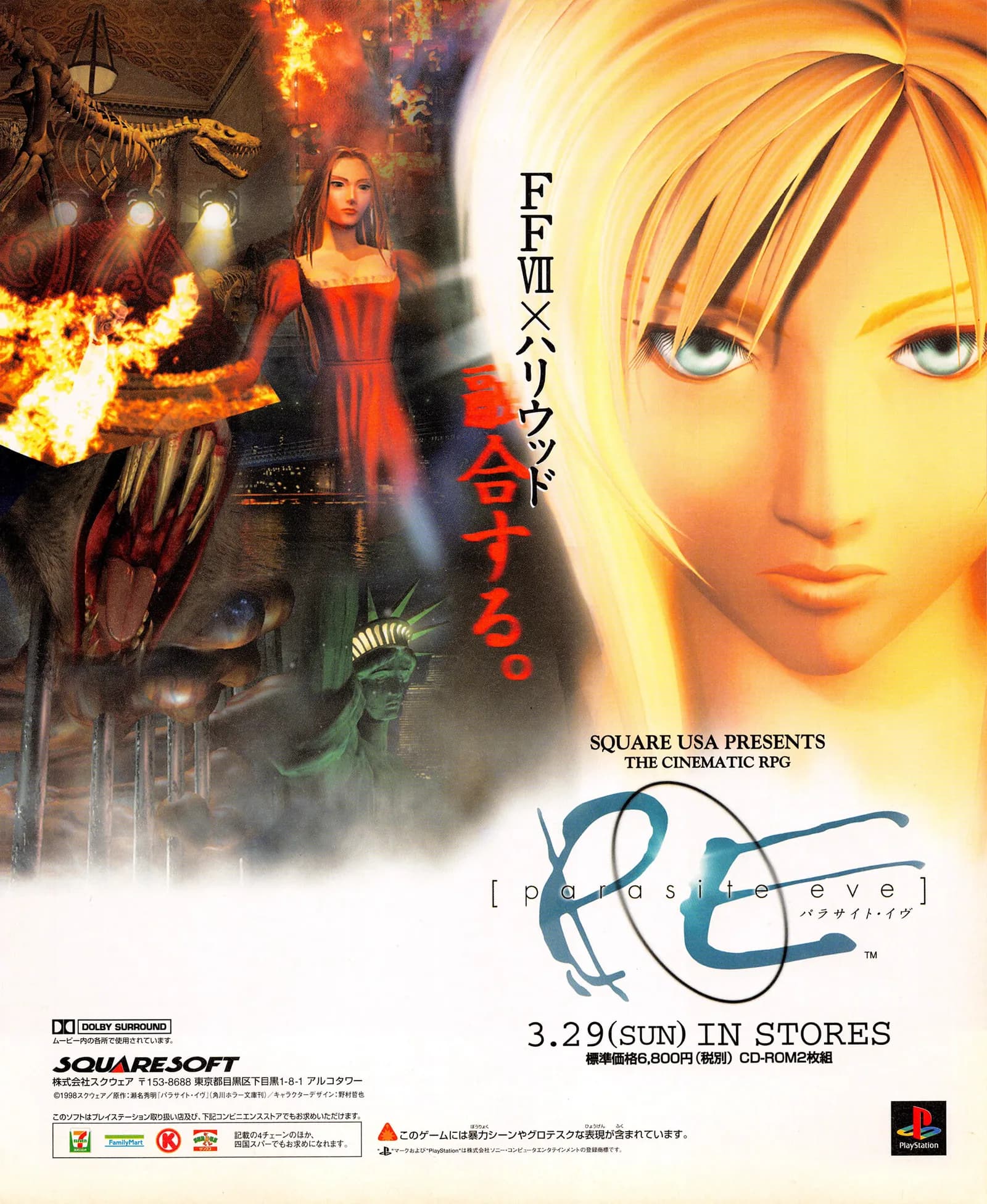
Dengeki PlayStation Vol. 66 · February 13, 1998
Parasite Eve in Dengeki PlayStation Vol. 66 + Dengeki Oh! Vol. 72
A Digital Domain Veteran, a Director’s First 3D Game, and the Release Date Nobody Remembers
Dengeki PlayStation Vol. 66 (February 13, 1998) · 6 pages, pp. 8–13 + Dengeki Oh! Vol. 72 (February 1998), pp. 29–31 · Game status: pre-release · Hardware: PlayStation · Developer: Square / Square USA · Coverage: pre-release scoop + CG movie reveal + NMC creature preview + developer interview
Dengeki Oh! Vol. 72, page 31, lists a release date of March 19, 1998. Parasite Eve shipped March 29. That ten-day delay is invisible in every retrospective source. No Wikipedia article, no Famitsu retrospective, no developer postmortem records it. It exists here, next to a price listed as 未定 (undetermined), in a six-question interview where the man credited as CGテクニカル・ディレクター is a Digital Domain veteran who worked on True Lies and Apollo 13 before joining Square USA.
Director Tokita Takashi is credited in the CREATOR DATA box on the same page but absent from the interview. He had directed Final Fantasy IV, Live A Live, and co-directed Chrono Trigger. This was his first PlayStation game, his first 3D game, and his first international co-production. The same month, Dengeki PlayStation Vol. 66 ran nine pages under the Dengeki Scoop No. 1 badge. Five of them carry ‘MOVIE’ as the dominant page header. The game was marketed as a film you played. Behind that marketing was a pipeline stretching from Tokyo to Los Angeles to Honolulu, staffed by people from Digital Domain, Rhythm & Hues, and Disney Imagineering, whose biggest problem, as Steve Gray told this magazine, was language.
1998 television commercial — via @kunta_
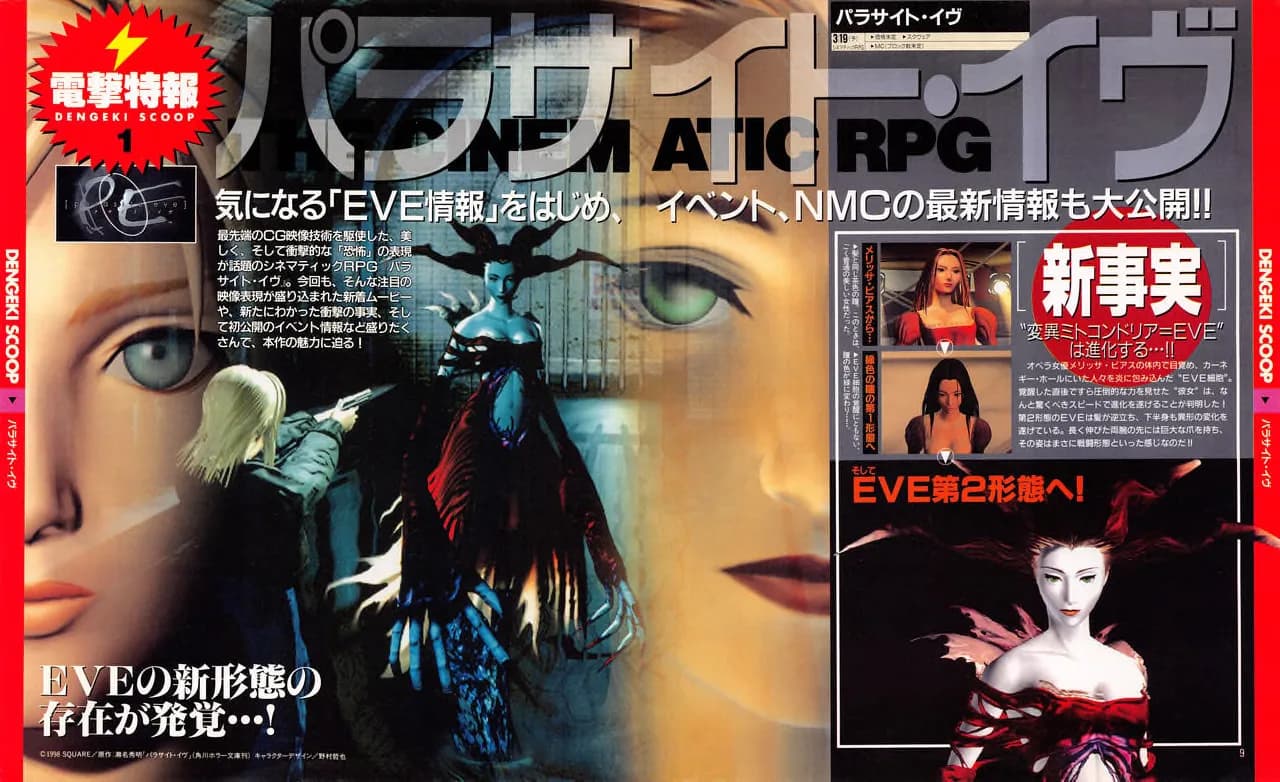
Pages 8–9. Dengeki Scoop No. 1. 新事実: 変異ミトコンドリア=EVEは進化する…!! — EVEの新形態の存在が発覚…!
Dengeki Scoop No. 1
The Dengeki Scoop badge, DPS’s label for exclusive pre-release access, was assigned to five titles in Vol. 66. Parasite Eve got slot No. 1 and six pages. Xenogears, which would ship three weeks after PE, received two pages at No. 3. Square had shipped Final Fantasy VII thirteen months earlier, and every RPG they released in 1998 carried that afterglow.
The subtitle reads ‘EVEの新形態の存在が発覚…!’: the existence of EVE’s new form has been discovered. EVE’s second evolutionary form hadn’t been publicly shown before this issue. Square gave DPS the reveal.
The Movie Before the Game
Five of the six Dengeki Scoop pages carry ‘MOVIE’ as the dominant header. The magazine is presenting footage, not gameplay.
The CG was produced at Square USA’s Los Angeles office. Additional sequences came from Rhythm & Hues, Santa Barbara Studios, and 3DSITE Inc. By 1998 standards, the pipeline was closer to a film production than a game development.
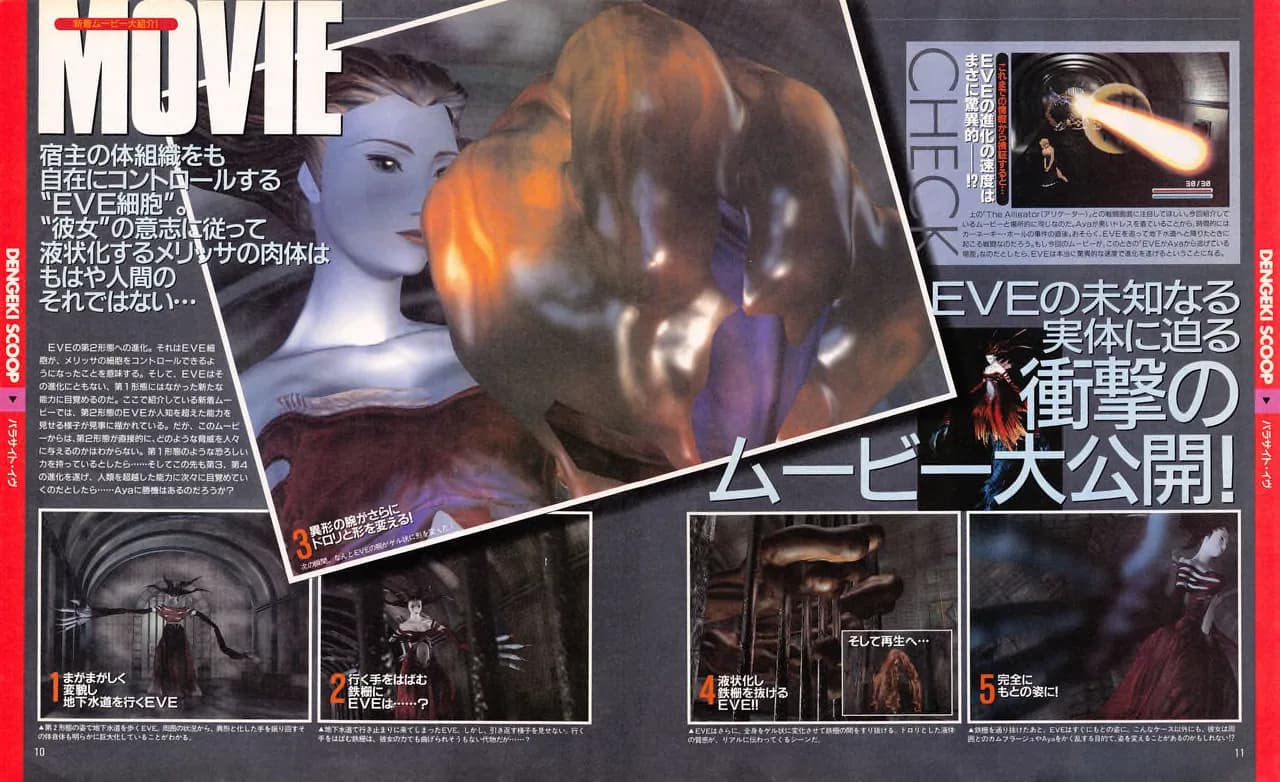
Pages 10–11. ‘MOVIE’ + ‘CHECK’. EVEの未知なる実体に迫る衝撃のムービー大公開! — transformation sequence stills 1–5: liquefaction, reconstitution, EVE second form.
Carnegie Hall
The Carnegie Hall sequence is the game’s opening: Melissa Pearce is performing on stage when EVE manifests through her body and the audience begins to combust. In the Dengeki Oh! interview, Sakaguchi reveals a detail the DPS coverage doesn’t mention. The crowd panic scene required custom software.
「冒頭のカーネギー・ホールで大勢の人が逃げまどうシーンで、簡単に計算ができる特別なプログラムを新たに作り上げ、それによって実現させています」
We created a special program from scratch that could handle those calculations efficiently, and that’s how we realized the opening Carnegie Hall scene where a crowd of people flees in panic. Custom crowd simulation for a PS1 RPG’s opening cutscene, built from nothing because no existing tool could do it.
NMC (New Mitochondria Creatures) is the game’s name for organisms transformed by EVE’s mitochondrial influence. The creature designs follow the biology: EVE’s evolutionary experiments on whatever fauna was nearby. A Central Park polar bear becomes a fifteen-foot predator. The horror premise is biological and consistent.
The Allocator
Page 11 carries a technical sidebar that most PE coverage doesn’t include: a name for the CG rendering system. Square used middleware called ‘The Allocator’ to produce the EVE transformation sequences, the liquefaction-to-reconstitution pipeline that was the game’s visual signature.
A named rendering system in a pre-release consumer magazine is unusual. Square wanted the pipeline itself identified as a credential. In hindsight, ‘The Allocator’ sits at the start of a trajectory that would end in Honolulu. Square had opened a second US studio there in 1997, already moving toward what would become Square Pictures and Final Fantasy: The Spirits Within.
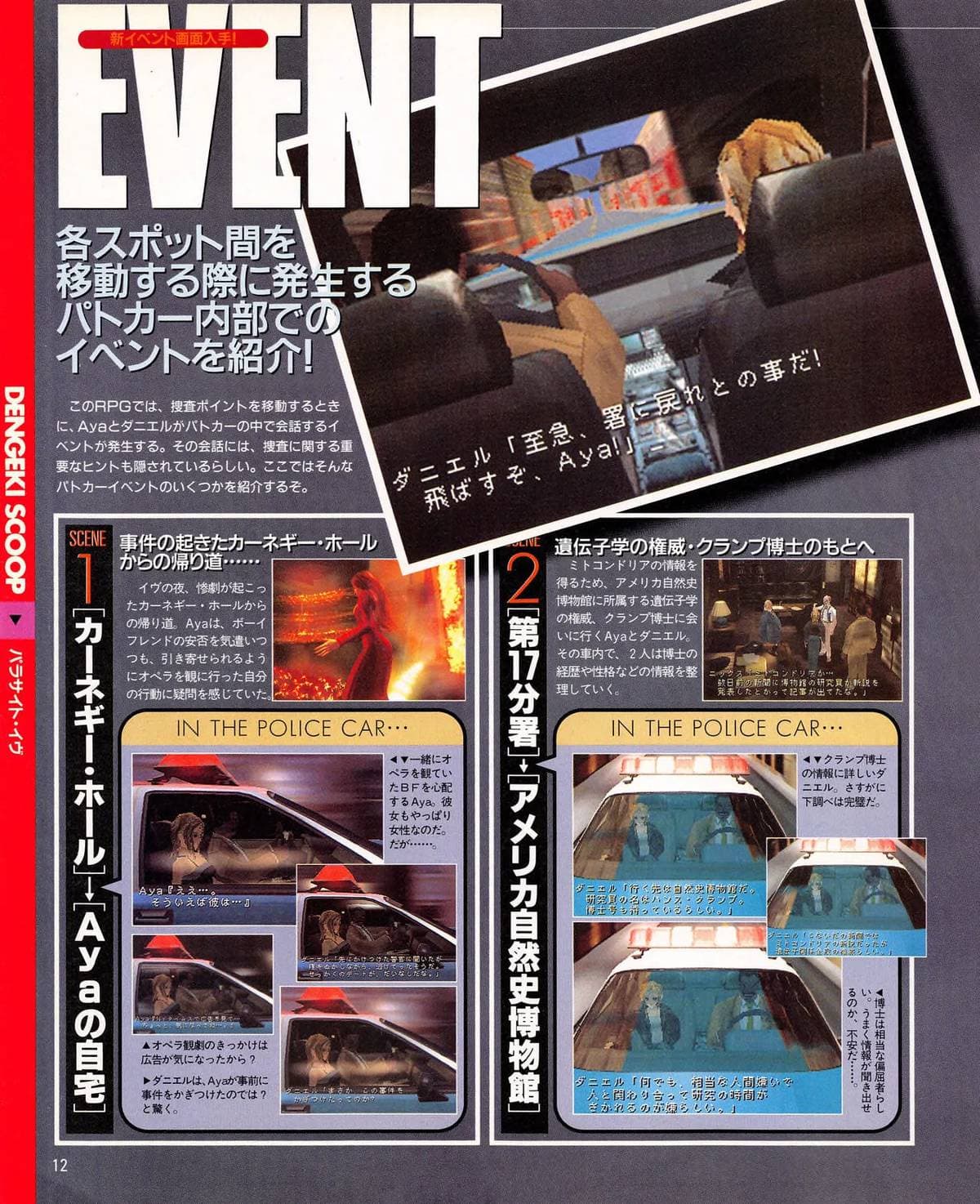
Page 12. Police car events: Carnegie Hall → apartment → American Museum of Natural History.
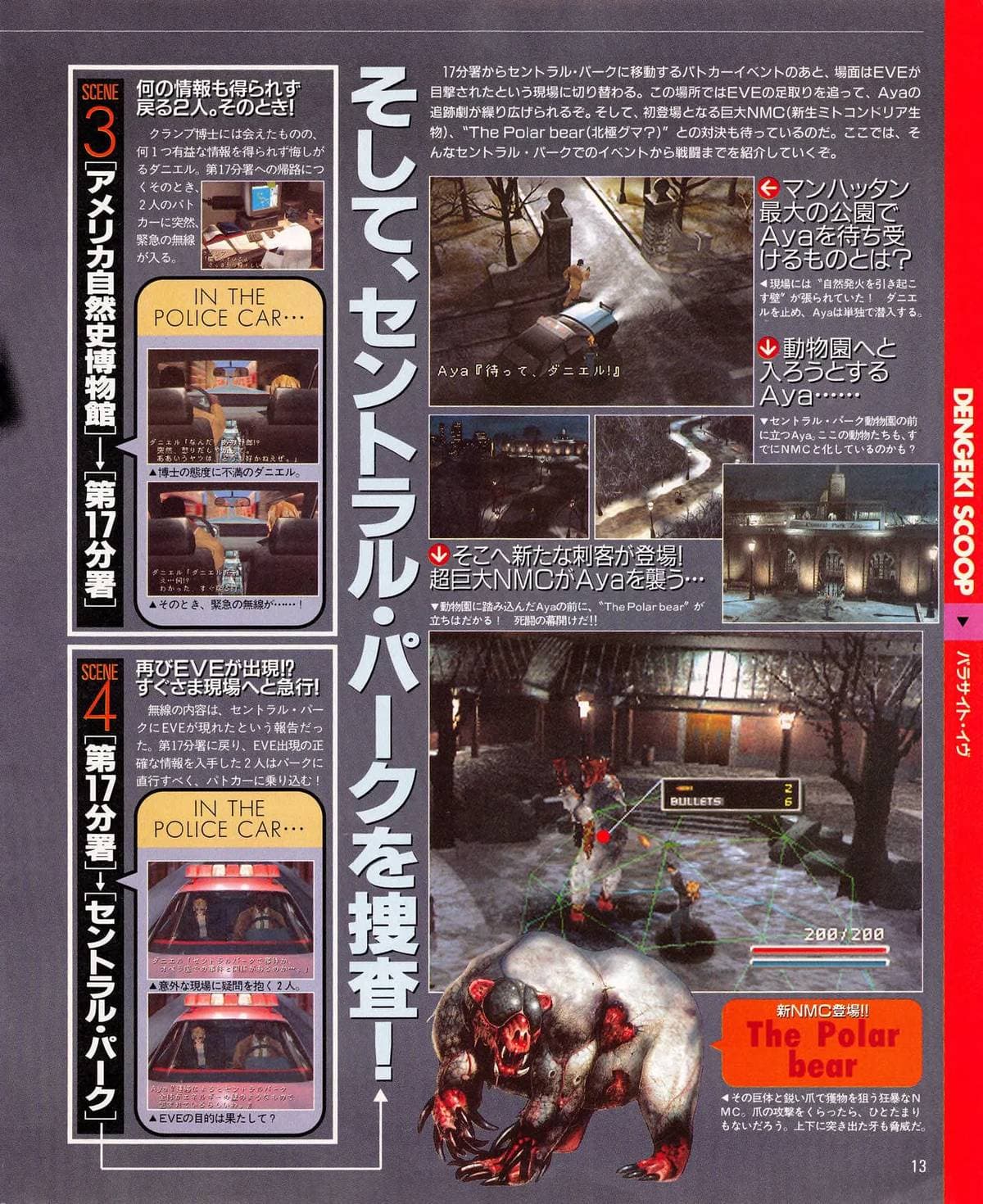
Page 13. EVE reappears → Central Park. The Polar Bear NMC: first public reveal.
The Police Car
The police car event system runs counter to everything else in this spread. Between each of Manhattan’s combat areas, Aya and her partner Daniel have conversations in the car. Two characters in close quarters, talking. No action, no transformation sequences. DPS gave these scenes comparable real estate to EVE’s mutation storyboard.
The Polar Bear NMC that closes page 17 is immediately preceded by one of the car conversations. The intimacy of the police car against the spectacle of a zoo animal scaled beyond recognition. Tokita Takashi, the director who had wanted to be a theater actor before joining Square, had staged this kind of pacing before in Final Fantasy IV: quiet scene, then violence. The magazine documented both without editorializing about the contrast.
The Same Month, Across the Rack
Dengeki Oh! Vol. 72 reached newsstands the same month. Its ‘1998 Big Chase’ feature listed eleven anticipated games: Zelda: Ocarina of Time, Dragon Quest VII, Mother 3 among them. Parasite Eve received two pages. One line in the overview, then a full-page interview. The headline: ‘ゲームにおける映像表現の進化はどこまでいけるのか?’ How far can visual expression in games evolve?
Where DPS Vol. 66 showed the answer in CG stills, the Dengeki Oh! interview reveals who was building it, what it cost them, and a release date the game would miss by ten days.
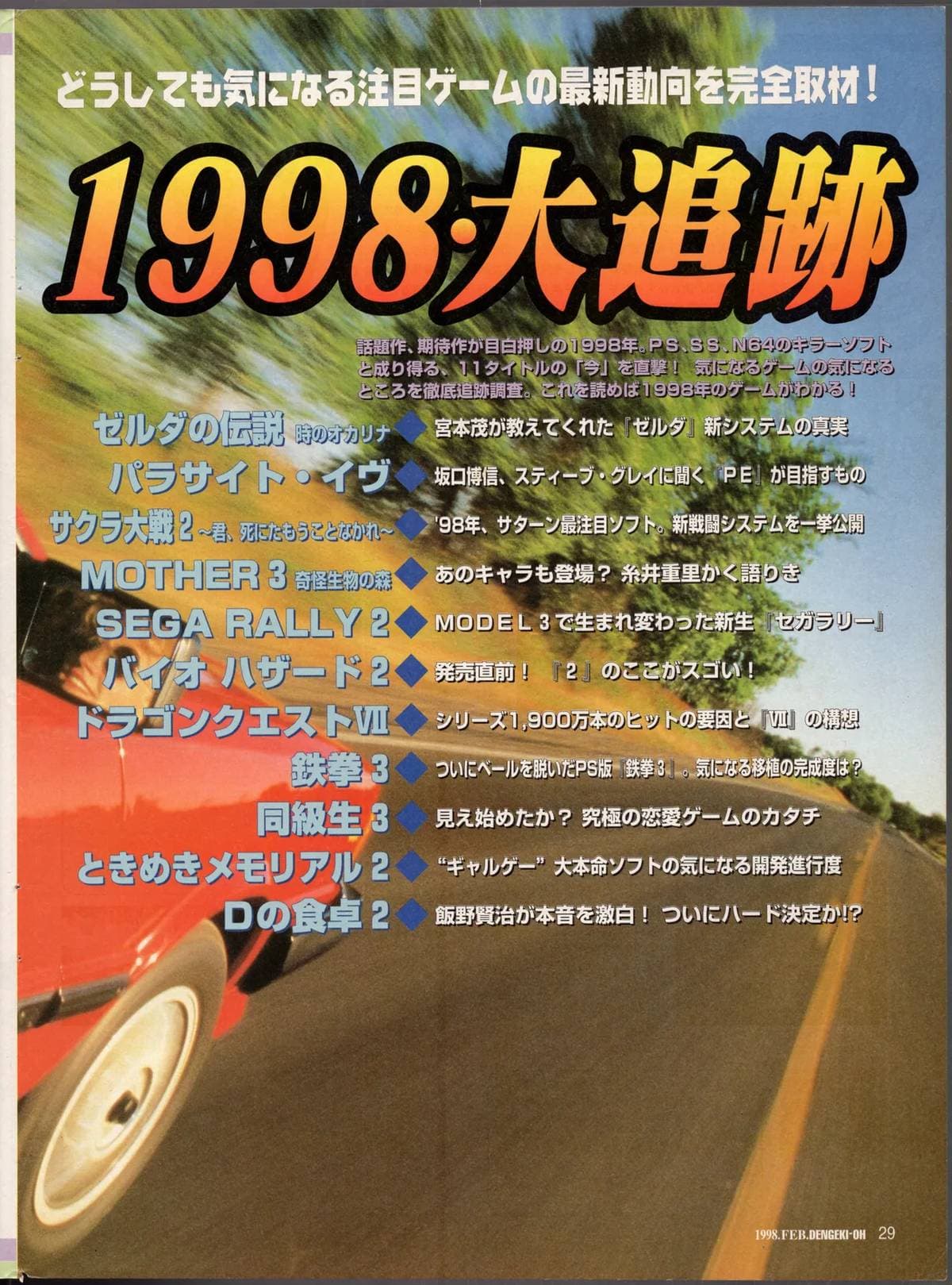
Page 29 (Dengeki Oh! Vol. 72). ‘1998 大追跡’ — eleven anticipated titles. Parasite Eve second on the list.
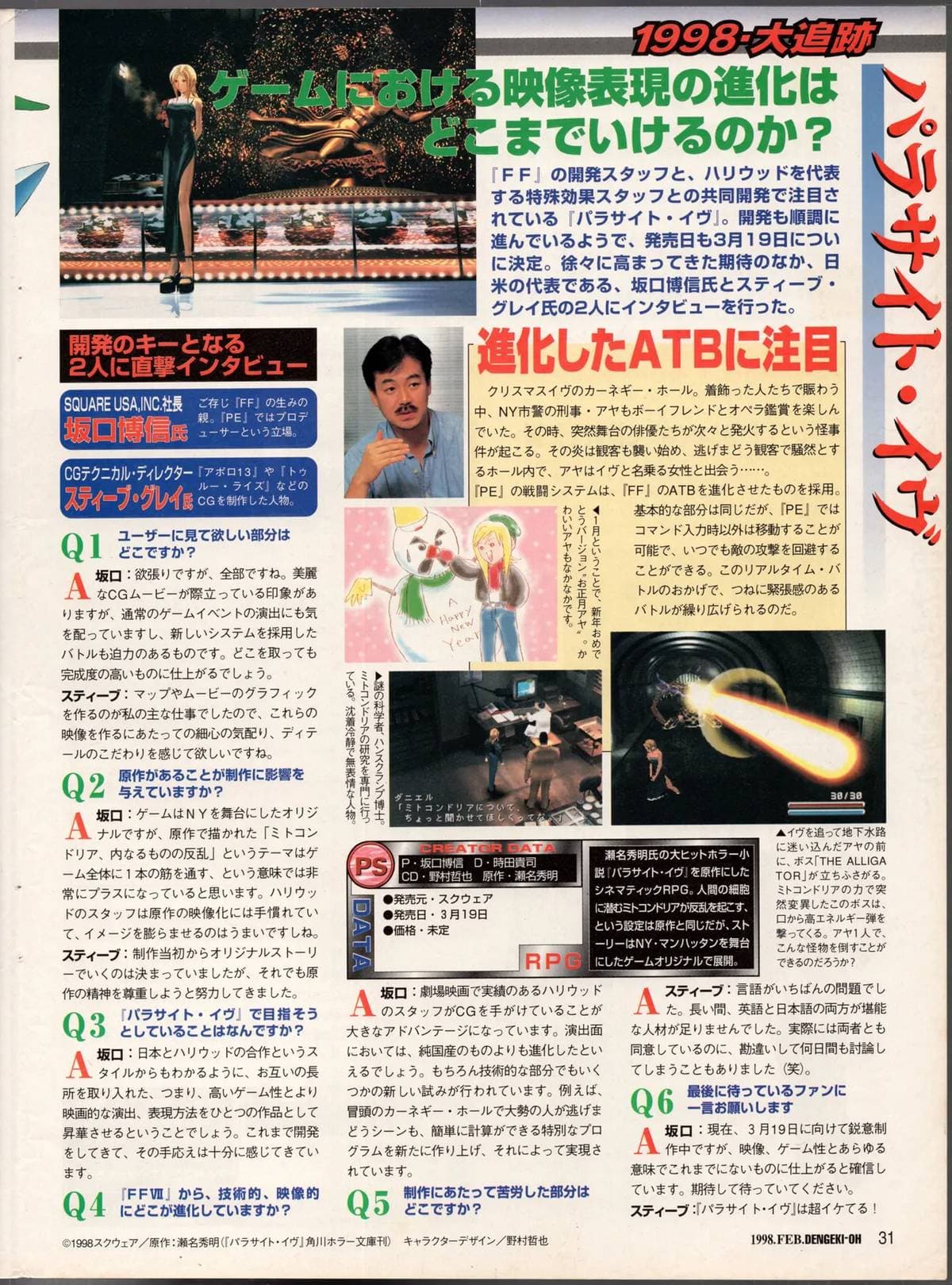
Page 31 (Dengeki Oh! Vol. 72). Six-question interview. Sakaguchi Hironobu: SQUARE USA, INC. 社長. Steve Gray: CGテクニカル・ディレクター (Apollo 13, True Lies). Release date: 3月19日. Price: 未定. CREATOR DATA: P・坂口博信 D・時田貴司 CD・野村哲也 原作・瀬名秀明.
The Language Problem
The interview credits Steve Gray as CGテクニカル・ディレクター and identifies him as the person who ‘created CG for Apollo 13 and True Lies.’ That undersells his résumé. Gray came from Digital Domain, the VFX house co-founded by James Cameron, where he’d worked on those films and won a Bronze Lion at Cannes for the Budweiser ‘Ants’ commercial. Before that, he ran the software department at Rhythm & Hues, writing particle systems and rendering code before commercial CG packages existed. He’d built EA Canada’s first motion capture lab. His role at Square USA was closer to Vice President, managing the American side of production.
When asked about the biggest production difficulty (Q5), Gray’s answer was immediate:
「言語がいちばんの問題でした。長い間、英語と日本語の両方が堪能な人材が足りませんでした。実際には両者ともに相手の言語に同意しているのに、勘違いして何日間も討論してしまうこともありましたし(笑)」
Language was the biggest problem. For a long time they lacked staff fluent in both. Teams would actually agree but misunderstand each other, and argue for days. He’s laughing about it.
Twenty-eight years later, Tokita would describe the same experience differently: ‘スタッフを信じて待つ胆力を鍛えてくれた作品です.’ The project that taught him the fortitude to trust his staff and wait.
Gray’s closing comment to fans (Q6): ‘パラサイト・イヴは超イケてる!’ Roughly, Parasite Eve is hella cool! A Digital Domain veteran closing a serious developer interview in 1990s Japanese slang.
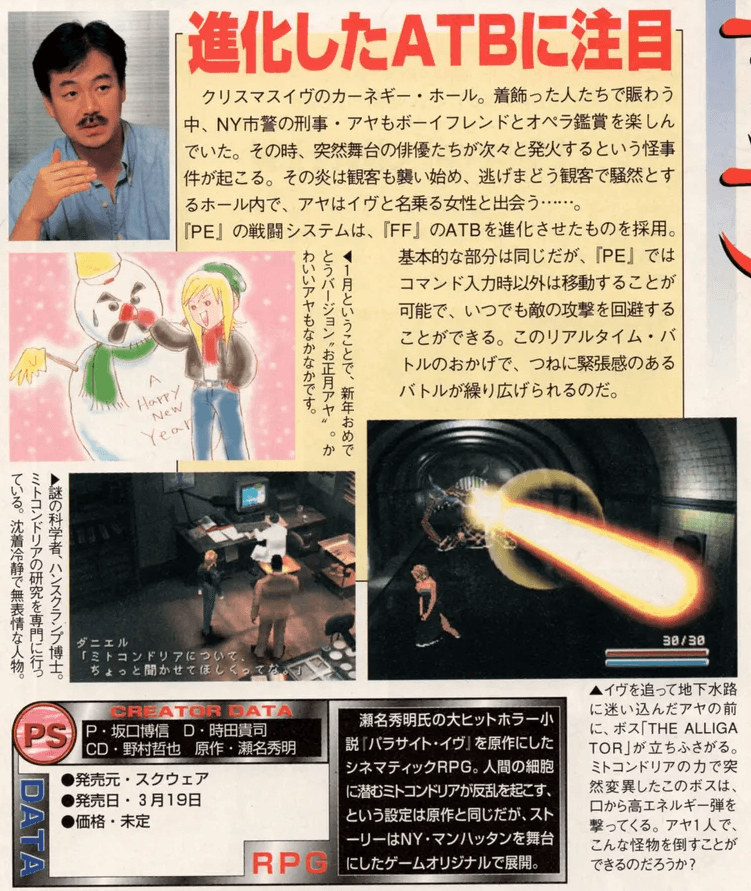
Dengeki Oh! Vol. 72, p.31. ‘進化したATBに注目’ sidebar. Creator Data: P·坂口博信 D·時田貴司 CD·野村哲也 原作·瀬名秀明. 発売日: 3月19日. 価格: 未定.
The Evolved ATB
The interview page carries a sidebar: ‘進化したATBに注目’ (Pay attention to the evolved ATB). The game inherited Final Fantasy’s Active Time Battle but made one structural change: during the ATB gauge charge, the player can freely move Aya around the battlefield. You dodge in real time, then issue commands when the gauge fills.
The magazine’s own description: ‘このリアルタイムバトルのおかげで、つねに緊張感のあるバトルが繰り広げられるのだ.’ Thanks to this real-time battle system, tense battles constantly unfold. The word is 緊張感: tension. The combat was designed to keep you uneasy.
Two magazines, same month, same game, different jobs. Dengeki PlayStation Vol. 66 showed readers what Parasite Eve looked like: nine pages of CG stills produced across three countries. Dengeki Oh! Vol. 72 explained who built the pipeline and what it cost them. Between the two, they documented the moment a Japanese RPG studio committed to making something that played like an action game, structured its story like a film, and shipped with CG sequences that held up against anything on PlayStation.
Twenty-eight years later, director Tokita Takashi, credited on page 31 but absent from the interview, described the production: ‘初のPS、初の3D、初の海外開発と初物づくしで苦難の連続.’ First PS1 game, first 3D, first overseas co-development. A string of firsts and a string of hardships. But the CG coming in from the Hollywood team moved him, and he finished on a high. The project that taught him the fortitude to trust his staff and wait.
Parasite Eve sold 1.14 million copies in its first week in Japan. The release date on page 31 reads March 19. The price reads undetermined. The game shipped March 29 at ¥6,800.
Sources
- Dengeki PlayStation Vol. 66 — Primary source, February 13, 1998, pp. 9–17
- Dengeki Oh! Vol. 72 — Primary source, February 1998, pp. 29–31
- Tokita Takashi (@TokitaTakashi) — Anniversary tweet, March 29, 2026
Limited Event
THE CINEMATIC RPG
Parasite Eve anniversary banner — pull EP, LG, and MY rarity artifacts from the full PE collection
Open the Archive →